
Hydrogen-Deuterium Exchange Mass Spectrometry (HDX-MS)
You Medico is one of the few providers in the world offering HDX-MS services.
In biopharmaceutical development, particularly the development of antibody drugs, it is essential to rapidly identify the epitope site on the antigen that binds to the antibody. In the development of biosimilars, it is necessary to confirm equivalence through comparison of higher-order structures with the reference biologic and to evaluate batch-to-batch variability in the three-dimensional structure.
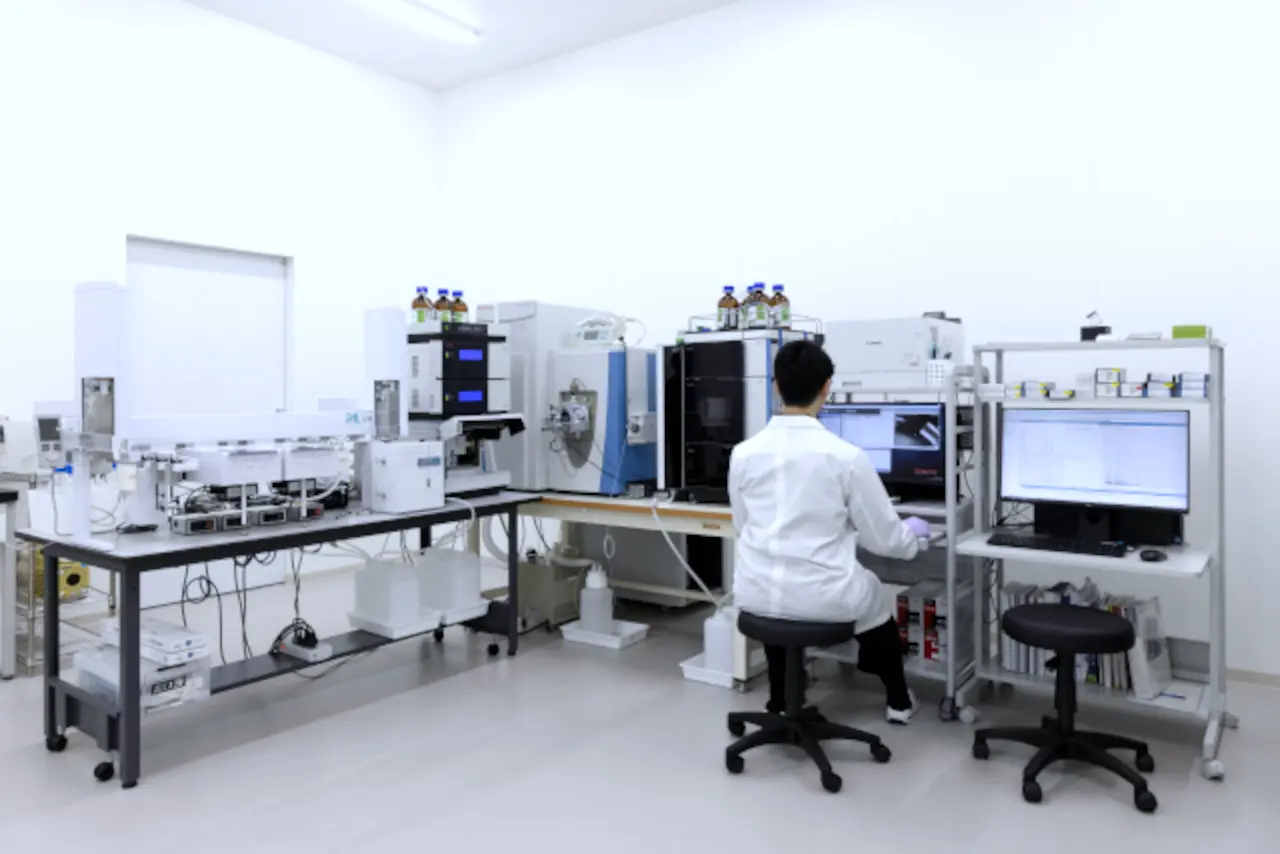
HDX-MS System
Hydrogen/deuterium exchange mass spectrometry (HDX-MS) is a technique that reveals protein structural changes and protein-protein interaction sites by monitoring, over time, the exchange reaction of hydrogen to deuterium in amide protons of proteins present in heavy water.
HDX-MS has no molecular weight restrictions on target proteins. Furthermore, it does not require labeling or crystallization, enabling the rapid identification of interaction sites within protein complexes faster than X-ray crystallography.
Since launching its HDX-MS contract services in 2013, U-Medico has completed over 40 projects, providing services such as protein-protein interaction analysis (epitope determination), protein-small molecule interaction analysis, and biosimilar equivalence evaluation.Our service features exceptionally high sequence coverage, typically exceeding 90%, and even for difficult-to-analyze membrane proteins, we provide analysis with coverage exceeding 80%.
| Test Method | Content |
|---|---|
| Epitope Determination | By comparing the deuteron exchange rate of the antigen alone with that of the antigen-antibody complex, regions showing a decrease in rate are identified as candidate epitopes—sites possessing antigenicity that bind to the antibody. |
| Structural Comparison of the Same Protein |
This procedure is performed to demonstrate structural equivalence between a biosimilar and its reference biologic, or to demonstrate structural equivalence between lots of the same protein. 2 Regions showing differences in deuterium exchange rates between states are identified as regions with structural differences in solution. |
| Protein- Small Molecule Interaction Analysis |
By comparing the deuteron exchange rates of proteins alone with those of low-molecular-weight–protein complexes, we identify regions where a decrease in exchange rate is observed as the binding sites of low-molecular-weight compounds to proteins. |
| Protein-Protein Interaction Analysis | By comparing the deuterium exchange rates of monomers with those of heteroprotein complexes, we identify regions showing reduced exchange rates as binding sites for the heteroprotein complexes. When preparation is possible using monomers, the binding site of the homodimer can also be determined. |
Native MS
By lowering the vacuum level in the mass spectrometer chamber and performing gradual desolvation, it is possible to measure the mass of protein-ligand complexes without disrupting non-covalent interactions. This method, known as mass spectrometry (MS) under non-denaturing conditions or native MS, enables the clear determination of protein-ligand interactions.
Mass Analysis
Peptide mapping enables analysis of post-translational modifications in proteins, such as oxidation, disulfide bonds, and deamidation. Additionally, intact MS provides precise mass measurements of proteins.
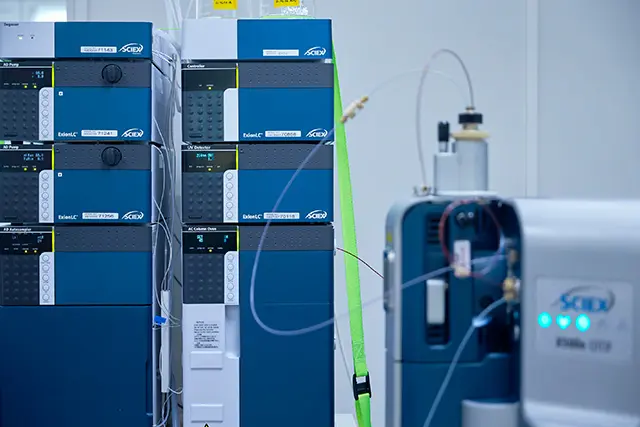
LC-MS/MS System